Essential-load assessment
Separate appliances that must stay on from those that can wait. Include starting demand, average use and desired runtime.

Choose backup around the appliances you need and the hours that matter.
Solar battery storage can reserve energy for evenings or supply selected loads during an outage with a compatible backup system. Resicon Energy helps customers in Pakistan compare options against essential loads, existing equipment and intended runtime. A proposal should state usable capacity, power limits and operating assumptions, alongside installation requirements and warranty conditions.
Explore your solar potential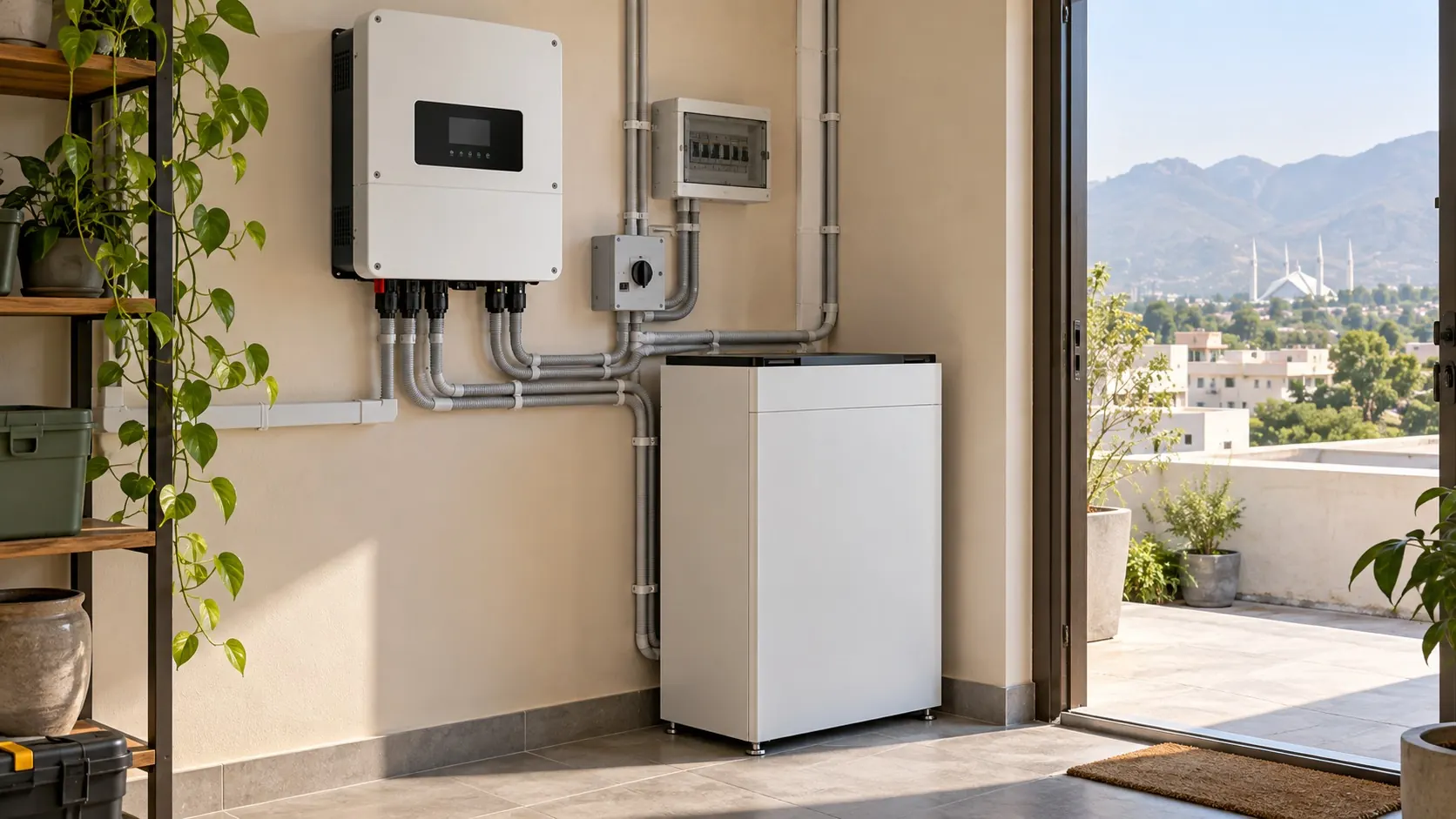
Separate appliances that must stay on from those that can wait. Include starting demand, average use and desired runtime.
Compare usable kWh with battery and inverter power ratings. Nameplate capacity alone does not establish appliance runtime.
Check battery model, voltage, communications and inverter configuration. Batteries are not interchangeable just because capacities match.
Agree priorities such as backup reserve or solar self-consumption. Follow equipment instructions and connection requirements.
Check manufacturer requirements for location, temperature, spacing and protection. Lithium batteries still need correct installation and inspection.
Compare time, throughput, retained-capacity and permitted-use conditions. Future expansion depends on compatibility rules.
Clear steps, from the first conversation to a working system.
List appliance ratings and required hours. Identify devices needing a particularly short transfer time.
Check inverter, space and wiring, including whether essential-load circuits are needed.
Review usable capacity, output, compatibility and a runtime estimate with visible assumptions.
Install equipment and protection, then set charging priorities to the accepted design.
Test supported modes and explain reserve levels, monitoring, limits and service contacts.
Runtime depends on usable energy and connected load. For illustration, 8 kWh of usable energy serving a steady 1 kW load equals eight hours before conversion losses and other limits. Real appliances cycle and start at different powers; request a load-based estimate.
It may, if the inverter and battery support running and starting demand. Runtime also depends on room conditions, thermostat settings and other loads. Share the exact model and intended usage rather than relying on a generic appliance count.
Assess the inverter and storage architecture. Options may include a compatible hybrid inverter or suitable AC-coupled arrangement. Confirm electrical ratings, controls and backup behaviour before choosing a retrofit.
kW describes power supplied at a moment. kWh describes energy stored or delivered over time. Both matter: a large energy capacity does not mean every high-demand appliance can run at once.
No battery is risk-free. Routine care varies, but operating limits and inspections still matter. Follow manufacturer instructions and report damage, swelling, unusual heat or alarms to a qualified service provider.
Transfer behaviour depends on inverter, mode and circuit arrangement. Sensitive devices may need a dedicated UPS or other approved design. Verify requirements before relying on solar storage for critical medical, IT or process equipment.
Get a free initial conversation about your electricity use, system options and site survey. Share a few details and our team will follow up.
No bill document is required here. Our team can arrange a secure way to review it with you.
Start with a conversation. We’ll help you understand your space, your energy needs, and your next step.
Or call +92 300 0403826